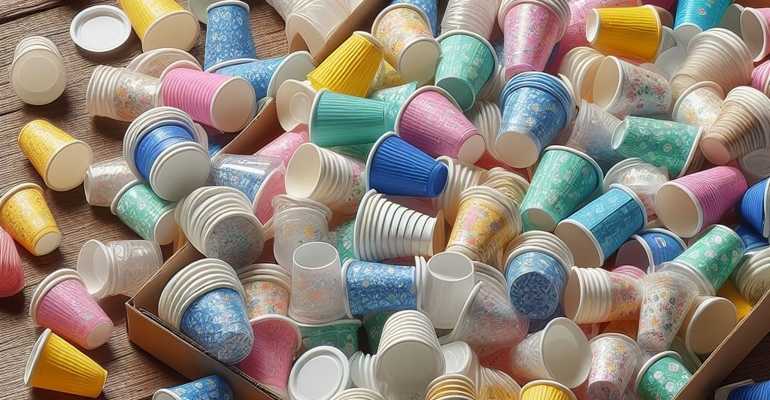
IIT Kharagpur research proved the existence of micro-plastic pollution in hot liquids consumed from disposable paper cups.
The present-day practice of serving market tea in paper cups is very harmful to health. Because the paper does not get soaked, a thin plastic layer is placed inside it.
Recent research from IIT Kharagpur has thus confirmed the existence of micro-plastics and other hazardous components and contaminant particles from the cup's lining material. Paper cups are usually lined with a thin layer of hydrophobic film, often made of plastic (polyethylene) and sometimes co-polymers, to keep liquids in the paper cup.
Prof. As Sudha Goyal says, “According to our study, 25,000 micron-sized (10 µm to 1000 µm) micro-plastic particles are dissolved in 100 ml of hot liquid (85 – 90 oC) for 15 minutes in a paper cup. The average person who drinks three regular cups of tea or coffee ingests 75,000 tiny micro-plastic particles. which is permanently stored in his brain, kidney or liver with the possibility of future cancer.”
In an Envitro lab, researchers followed two different procedures—in the first procedure, hot ultrapure (MilliQ) water (85–90 C; pH~6.9) was poured into disposable paper cups and allowed to sit for 15 minutes. The homogenized mixed water was then analyzed for the presence of micro-plastics as well as additional ions that may have leached from the paper cup into the liquid. In another procedure, paper cups were initially immersed in warm (30–40 °C) MilliQ water (pH~6.9). Then, the hydrophobic film was carefully separated from the paper layer and exposed to warm MilliQ water (85–90 °C; pH~6.9) for 15 min. And the changes in the physical, chemical and mechanical properties of the plastic films were examined before and after exposure to hot water.
Explaining the 15 minute exposure, Prof. Goyal tied his premise to a survey in which respondents confirmed within 15 minutes of consuming their drink.
"Apart from the survey result, it was also observed that within this time, the beverage had attained its ambient temperature,” she said.
These micro-plastics can act as carriers for contaminants such as ions, toxic heavy metals such as palladium, chromium and cadmium and organic compounds that are similarly hydrophobic in nature so that they can easily enter animal cells.
Considering whether traditional pottery, glass cups, and brass vessels might be more suitable replacements for such disposable items, Prof. Virendra K Tiwari, Director, IIT Kharagpur, pointed out, “This study shows that paper cups need to be carefully considered before using them permanently.
In the country with the largest production and sale of tea, we are in a hurry to replace plastic cups with disposable paper cups for dangerous products and environmental pollutants.
We are here to help you...